
Smith County Release Meanings
A Smith County release record documents the end of one stay at the Smith County Detention Center. It does not always mean the person entered the community. The jail holds both pretrial and sentenced adults, so a person can leave on bond, after time served, under a court order, or by transfer to another agency. The event must be read in relation to the booking that ended. A transfer to MDOC, another county, a federal custodian, or immigration custody is still continued confinement elsewhere.
The official Smith County Sheriff page points to a current-inmate roster. Once a booking ends, the name normally drops from that view. The Sheriff remains the owner of the county booking and release entry. MDOC owns state prison and supervision records, while a court clerk owns judgments and docket entries. Each source answers a different part of the timeline.
- Release
- The end of a particular custody stay, including a community exit or transfer.
- Discharge
- A stronger agency term for completion of a sentence or supervision obligation.
- Time served
- A sentence or court outcome satisfied by time already spent in custody.
- Detainer
- A hold from another agency that may prevent a community exit.
Smith County Release Types
The recorded release type controls the next lookup. A bond or recognizance entry usually concerns pretrial release and does not decide the case. A dismissal or time-served order may explain legal authority, but staff processing and other holds still affect the actual exit. Parole and earned-release supervision involve continued MDOC jurisdiction. A transfer ends county control without ending custody.
| Recorded event | What it means | Next record |
|---|---|---|
| Bond or recognizance | Conditional pretrial release on that booking | Jail release entry and court case |
| Time served or court order | Authority to end the county stay | Signed order plus actual jail exit |
| Parole or ERS | Release from confinement into supervision | MDOC parolee record and Board or Records confirmation |
| Transfer | Custody moved to another agency | Receiving-agency admission or locator |
| Sentence discharge | Agency records completion of its sentence control | Discharge certificate or Records response |
Can a person post bond and remain confined? Yes. Another charge, warrant, detainer, or transfer order may control. “Bond set” and “bond posted” are not the same as a timestamped Smith County community release.
Smith County Release Record Fields
A useful county record ties a specific person to a specific booking and shows what ended that stay. Ask for fields as the jail maintains them. Do not ask staff to translate an unknown code into a preferred description or to create a new analysis. The recorded destination is vital when roster removal might mean transfer.
| Field | What it shows |
|---|---|
| Name and booking number | The identity and exact jail stay covered |
| Booking date and time | When Smith County admitted the person |
| Actual release date and time | When that county stay ended |
| Release type or disposition | The jail’s recorded reason or authority |
| Receiving agency or destination | Whether custody continued elsewhere |
| Charges, cases, bond, and holds | Booking context and barriers that may have affected departure |
| Booking photograph | The image tied to that county admission, if retained and public |
The public roster is not this record. Its vendor design can contain release-related fields, but Smith County disables public past-inmate access. Online display time also differs from agency retention. No local retention period is published, so ask whether an older entry remains in the jail system, an archive, or a paper register.
Request Smith County Release Records
The county publishes no dedicated release-record form, records hours, or local fee schedule. Direct a narrow request to the Smith County Sheriff’s Office, 206 Courthouse Square, Raleigh, MS 39153, telephone 601-782-4531, fax 601-782-4003. Call first to confirm the current custodian, accepted delivery method, and inspection hours.
- Identify the person, booking number if known, and approximate admission or release date.
- Request the existing booking or release sheet and list the exact fields needed, including actual release time, disposition, and receiving agency.
- Ask for an electronic copy, lawful redaction reasons, and a cost estimate before work exceeds a stated limit.
- If staff deny or redact material, ask for the legal authority and any segregable public portion.
- Use the recorded transfer destination to continue the search with the next agency.
A date-bounded release-log request should use exact local start and end times. The Public Records Act generally concerns existing records, so the Sheriff need not build a new custom report if none is maintained. For an MDOC discharge, request the time sheet, release or discharge certificate, computation, and final status through the MDOC public-records route.
Note: A court order explains legal authority, while the jail release entry documents the physical custody event and any transfer.
Smith County Release Access Laws
The Mississippi Public Records Act provides the general access framework, subject to exemptions, redaction, court orders, and other statutes. Section 25-61-5 addresses response and production timing. An agency policy may allow up to seven working days for production. If that cannot occur, the agency must give particular written reasons, and production is generally due within fourteen working days absent agreement. Requesters should ask what Smith County policy applies instead of assuming the longest period.
Section 25-61-7 permits fees that reimburse actual search, review, duplication, and mailing costs. Section 25-61-9 addresses written denial. Juvenile information, sealed or expunged material, victim information, active investigative records, and security-sensitive fields may be restricted. A public record can also exist without being published online.
Roster absence is not proof of release. Request the Smith County release entry and identify any receiving agency.
Correct Smith County Release Records
Smith County publishes no single jail process for returning property, returning identification, or correcting a release record. The practical route follows ownership. Send a disputed booking or release field to the Sheriff. Send a docket or order issue to the correct clerk. Send a state prison or supervision issue to MDOC.
A focused correction request should identify the record, quote the exact field believed wrong, and attach a controlling order or other proof. Ask for the office’s correction procedure and a written outcome. One office cannot correct another agency’s database. A court’s sealing or expungement order may change public access, but the custodian must implement it in each affected system.
Mississippi’s expungement routes vary by charge, result, and offense. Section 99-19-71 includes a route for some arrests followed by release when the case was dismissed, charges were dropped, no disposition occurred, or the person was acquitted. It does not by itself establish the jail exit time.
Smith County Release Court Routes
After a name leaves the roster, court routing can explain the legal outcome. The Smith County courts page distinguishes jurisdictions. Circuit Court handles felonies and misdemeanor appeals. Justice Court handles many criminal violations outside municipalities and has preliminary powers. A municipal matter belongs with the relevant city court.
Smith Circuit Court joined its regional electronic court system in 2024, so older files may require direct clerk retrieval. Online flags such as Closed, Probation, Sealed, or Expunged are clues, not proof of a physical release. Read the docket sequence, judgment, amended orders, revocation filings, and dismissal entries. Then compare the controlling order with the Sheriff’s actual release field.
The Smith County Circuit Clerk maintains dockets, pleas, indictments, orders, minutes, and complete proceedings. A court record answers what happened legally. The jail record answers when the person left and whether another custodian took control.
Find Smith County Released Inmates
Start with a full name, spelling variants, approximate date of birth, booking or case number, arresting agency, date range, and likely jurisdiction. Keep sensitive identifiers private. Search paths fail when a user begins in the wrong custody system or treats a current roster as a historical archive.
- Check the Smith County current roster. A listing supports present county custody at the check time. An absence remains unresolved.
- Call the Detention Center and ask for the exact booking’s release date, disposition, and receiving agency. Request the release sheet if documentary proof is needed.
- If transfer to state custody is plausible, compare the MDOC inmate search and parolee search. They serve different statuses.
- Use the correct court to explain bond, dismissal, sentence, time served, or later orders.
- Use VINE for a reported custody event and federal or immigration locators only when that jurisdiction is supported.
- If all online results fail, narrow a records request instead of reporting an unconfirmed release.
The Smith County same-day release page explains the records fallback for recent activity. Smith County does not publish a verified public 24-hour or 72-hour release list.
Smith County MDOC Release Searches
MDOC uses separate tools. Its inmate search is suited to current state incarceration, while the parolee search is the better released-first route for a person under community supervision. Neither is guaranteed to be a complete historical discharge archive.
| Search | Inputs and fields | Meaning |
|---|---|---|
| MDOC inmate | Name or MDOC ID; result shows ID, name, location, term, offense, and View | State custody detail may include a Tentative Release Date |
| MDOC parolee | Name, MDOC ID, city, or county; Smith is selectable | Community supervision detail may show officer, county, and Flat Time Date |
| MDOC Records | Written request with name, ID, and requested documents | Best route for computation or final discharge proof |
The tentative date is an estimate, not proof of departure. A parolee result shows release from confinement into supervision, not final discharge. The official inmate-search screen illustrates the statewide entry point.
Open the MDOC inmate search before using the state screen shown below.
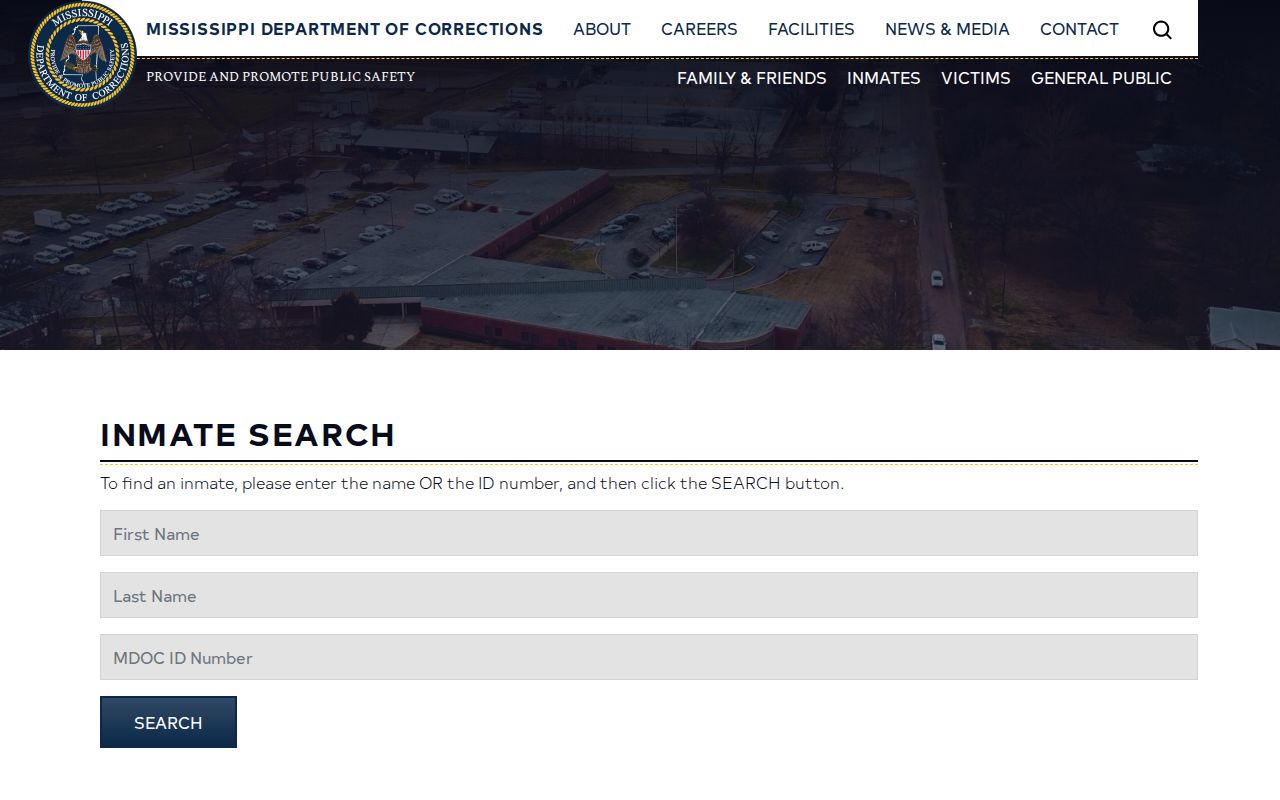
The image shows why MDOC identifiers and location fields must be compared with the Smith County transfer record.
Smith County Recent Release Gap
Smith County does not publish a verified recent-release feed. The roster vendor has generic past-inmate and “Books 24hr” code, but the county’s live configuration disables public past inmates. “Books” also describes bookings, not releases. No separate three-day view, update cadence, or online retention period was found.
For a fixed window, ask the Sheriff for an existing release log whose actual release timestamp falls between exact local start and end times. Request name, booking number, release time, disposition, and transfer destination when public. If no log exists, seek known booking or release sheets. The mobile view is a responsive web page, not a native jail app.
The official current roster shows the current-only interface captured here.
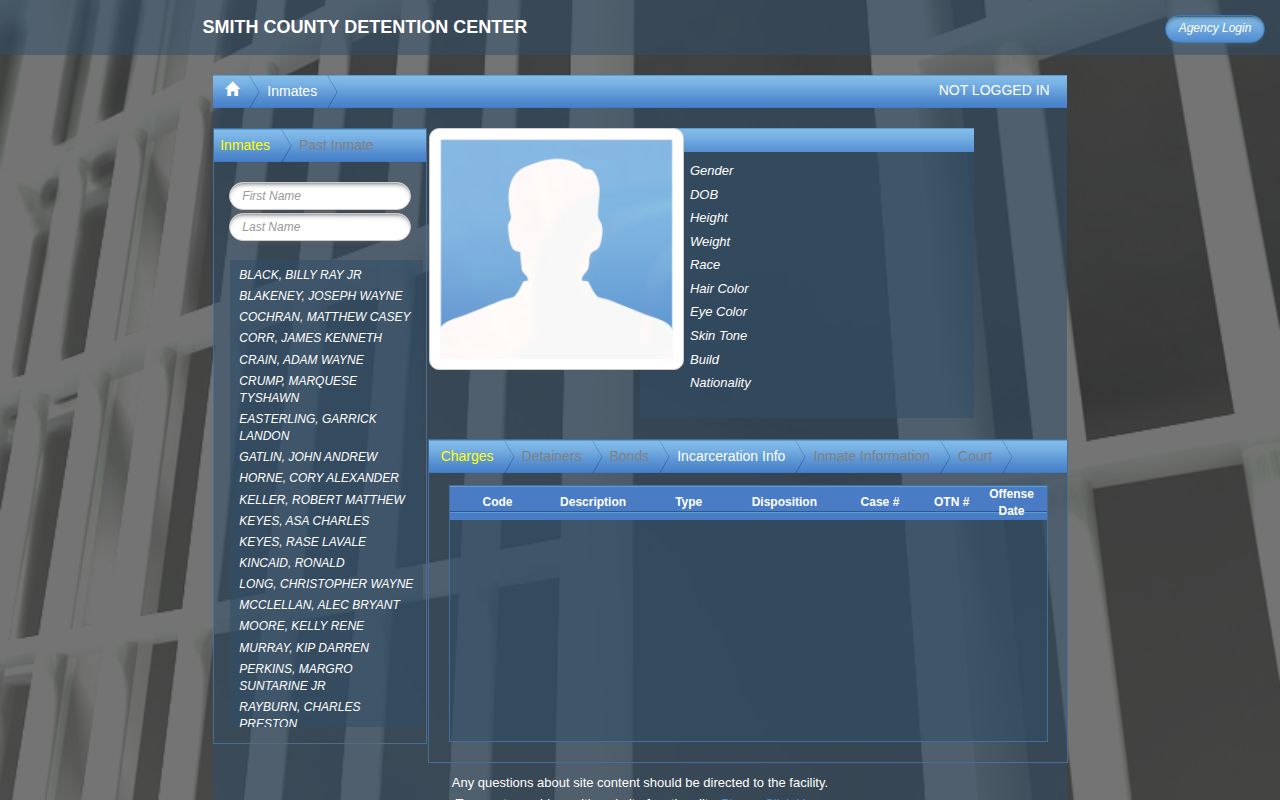
The locked past-inmate control supports the records-request fallback instead of an invented release list.
Smith County Release Supervision
Parole is conditional release authorized by the Mississippi State Parole Board. Probation is court-ordered supervision and may begin without a prison release. Earned-release supervision keeps the person in inmate status under MDOC jurisdiction while the sentence continues. These distinctions matter when a person is out of a cell but not fully discharged.
Search the MDOC parolee database by name or ID and use Smith County only to narrow results. A record can show supervision location, officer, offenses, and flat-time information. The Smith Probation & Parole Office handles local reporting and office-assignment questions at 230 Magnolia Drive in Raleigh. The full verification route appears on the Smith County parole and probation page.
No official public statewide absconder list was found. A missing parolee-search result does not prove a warrant, absconding, discharge, or a new custody event. Ask MDOC or the Parole Board for the status that office is authorized to confirm.
Smith County Release Notifications
VINELink can report release, transfer, return to custody, escape, or other events from participating county and state booking systems. Coverage depends on the reporting agency. A release alert means that agency reported a custody change. It does not decide the case, cancel a detainer, or prove complete sentence discharge.
Search one person by the fields offered, compare agency and identity details, then register for an available phone or email alert. Complete the live confirmation or PIN step. Mississippi SAVIN’s Registration Link can carry a registration when a county offender moves to MDOC or other custody. Treat a transfer notice as continued custody and confirm the receiving agency.
A failed VINE search may reflect spelling, lag, transfer, participation differences, or old-record removal. Call the jail when the result conflicts with county or court data.
Smith County Federal Release Boundaries
Federal and immigration tools are conditional branches. No BOP institution or dedicated ICE facility was found in Smith County. Use the BOP inmate locator only for federal custody. Its result can show name, register number, age, race, sex, release date, and location. “Released” or “Not in BOP Custody” concerns BOP control and may coexist with another justice system or federal supervision.
USMS manages many federal pretrial and transport matters but offers no public county-style historical release list. If the Smith County record says USMS transfer, follow the federal district and docket. Use the ICE locator only when an immigration detainer or transfer is supported. A departure from Smith County into ICE custody is not a community release.
Federal search results require the federal register number and docket context. They do not replace the Sheriff’s record for the end of a Smith County booking.
Compare Smith County Release Records
Match the question to the source. Current custody, county release, state supervision, court outcome, and federal status are separate facts.
| Question | Best source | Key limit |
|---|---|---|
| Still in the county jail? | Current roster and jail call | Roster absence does not prove release |
| When did the county stay end? | Sheriff booking or release sheet | A transfer may be continued custody |
| Now in state prison? | MDOC inmate search | Not a county release archive |
| Under state supervision? | MDOC parolee search | Not proof of final discharge |
| Why did the case change? | Correct court docket and order | Does not prove physical exit time |
| Out of federal custody? | BOP locator and federal record | Does not establish Smith County release |
What if every system says not found? Report only that no public match was located at the check time. Recheck spelling, identifiers, dates, and jurisdiction, then make a narrow request to the likely record owner.
Smith County Release Reentry Contacts
The Capital Central Reentry Resource Guide includes Smith County and regional contacts for purpose-neutral needs such as identification, transportation, legal help, and agency navigation. The PDF can age, so verify each entry against a current primary source before relying on it. The Sheriff controls local booking and release data. The clerk controls court records. MDOC controls prison and supervision information.
That ownership map also helps after release when a document is missing or wrong. A person seeking proof of the county exit should request the Sheriff’s release entry. Someone needing sentence-discharge proof should contact MDOC Records. A signed judgment or expungement order belongs with the appropriate clerk. Keeping those paths separate prevents an office from being asked to change data it does not own.
Smith County Release Outcomes and Holds
The Detention Center’s mixed pretrial and sentenced population makes roster removal especially ambiguous. Bond, time served, dismissal, and transfer are not interchangeable outcomes. A bond in one case may not overcome a detainer in another. A dismissal order may still require staff processing. A transfer record may show the county stay ended while the person remained confined.
Ask for the actual release disposition and receiving agency, not a broad statement that the person is “gone.” If the response says MDOC, search state custody. If it says USMS or ICE, follow that system. If it says community release, compare the timestamp with the court order and any supervision record. This sequence preserves the difference between legal authority, physical exit, and continued control.
Smith County Release Facilities
The project’s facility map includes the county jail plus four systems or offices that may hold, receive, supervise, or locate a person after the Smith County booking ends. Only the Detention Center is a confirmed county confinement facility. The local probation and parole office is not a jail, and no state prison, BOP institution, or dedicated ICE detention center was found within Smith County.
- Smith County Detention Center: county booking, current custody, and jail release record.
- Smith Probation & Parole Office: local MDOC community-supervision route.
- Mississippi Department of Corrections: statewide prison, parolee, and discharge records.
- Federal Bureau of Prisons: federal custody and historical release results.
- ICE / ERO Detention Network: immigration custody only when a detainer or transfer supports that branch.
A municipal arrest in Raleigh, Taylorsville, or Mize does not establish a separate long-term city jail. Confirm where the arresting department sent the person.