
MDOC Statewide Release System
The Mississippi Department of Corrections operates state institutions and community corrections across Mississippi. No MDOC prison was found within Smith County. A Smith County resident or a person convicted there may still enter MDOC custody elsewhere after sentencing and transfer. Residence does not determine the institution.
When the Smith County Detention Center record says transfer to MDOC, the county booking has ended but confinement continues. Search the state inmate system next. When a person later leaves an MDOC institution, the path may be parole, earned-release supervision, or discharge at sentence end. Each status needs its own proof.
Search MDOC Release Records
MDOC uses two public searches. The inmate search is best for active state incarceration. The parolee search is the released-first channel for active community supervision. Neither is guaranteed to serve as a complete historical archive after final discharge.
- Search the MDOC inmate lookup by name or MDOC ID when transfer or current state custody is plausible.
- Review ID, name, location, term, and offense, then open the detail.
- Search the separate parolee database for a person believed to be in the community under MDOC supervision.
- Use Smith County as a narrowing field only when the supervision assignment is expected there.
- Request the release certificate, discharge certificate, or computation record from MDOC Records when the public screens do not settle the event.
A “not found” result is unresolved. It may reflect spelling, stale data, transfer, an older discharge, or a record outside that search's scope. The Smith County release search can help establish whether the person began in county, state, federal, or immigration custody.
MDOC Release Search Fields
The inmate result displays ID Number, Last Name, First Name, Location, Term, Offense, and View. A detail can add a photograph, date of birth, entry date, location-change date, number of sentences, sentence length, sentence date, county of conviction, and Tentative Release Date. The parolee search accepts name, MDOC ID, city, and county and can show supervision detail.
| MDOC field | Meaning | Limit |
|---|---|---|
| Location | Current or displayed MDOC placement | May change after transfer |
| Term and offense | Sentence context shown in the result | Does not state physical departure |
| Tentative Release Date | Anticipated incarceration-release date after adjustments | Not a promise or actual release proof |
| Parolee county | Community-supervision area | Not final discharge |
| Flat Time Date | Sentence milestone in parolee detail | Not necessarily the prison exit date |
Compare identity fields carefully. Do not copy a residential address from any detail. An MDOC photograph is a state correctional image and should not be mistaken for the Smith County booking photograph.
MDOC Discharge Records Contact
MDOC Records is the right office for sentence computation, actual release documentation, and discharge status. The statewide contact is not a Smith County building. Written requests should identify the person by name and MDOC number or another suitable identifier, then name the existing documents sought.
MDOC Records DepartmentP.O. Box 24388
Jackson, MS 39225
Phone: 601-933-2889
Email: MDOCRecordsDepartment@mdoc.state.ms.us
Use the official MDOC contact directory to confirm current details
Useful records can include a time sheet, release or discharge certificate, actual release date and type, sentence-credit computation, and final custody or supervision status. The published public-record policy lists written handling through the MDOC public-record route. Request electronic delivery and an estimate.
Note: Contact the State Parole Board for its decision status, while MDOC Records handles computation and discharge documentation.
MDOC Tentative Release Records
Mississippi calculates several milestones. Tentative release is an anticipated incarceration-release date after applicable credits and adjustments. Maximum discharge reflects another endpoint. Earned-release supervision eligibility and parole eligibility are separate. None alone proves that a person left an institution.
For covered sentences, Miss. Code § 47-5-138 describes earned time and a ceiling that can produce an approximate 85 percent shorthand. Eligibility exclusions, disciplinary changes, jail credit, sentence structure, and MDOC review can alter the calculation. Earned-release supervision keeps the person in inmate status under MDOC jurisdiction through the relevant term. Parole follows separate law and Board action.
- Tentative release
- An estimated prison-release date that can change.
- Parole
- Conditional release authorized by the State Parole Board.
- Earned-release supervision
- Conditional community status while MDOC jurisdiction continues.
- Maximum discharge
- The projected sentence end under the applicable computation.
MDOC Release Versus Discharge
A parolee record supports release from confinement into supervision. It does not mean all sentence duties have ended. Earned-release supervision also keeps MDOC jurisdiction in place. A discharge certificate is the stronger record for the end of that jurisdiction.
| Event | Person's status | Confirm with |
|---|---|---|
| Smith County transfer to MDOC | Still in custody | County release entry and MDOC location |
| MDOC prison release to parole | In community under supervision | Release record, parolee detail, Board action |
| MDOC release to ERS | In community under MDOC jurisdiction | MDOC release and computation records |
| Final discharge | Sentence jurisdiction ended as recorded | Discharge certificate or Records response |
Use the issuing agency's terms. “Released” is relational to one custody stay. “Discharged” often carries a broader sentence-completion meaning, but the actual certificate controls.
Request MDOC Release Documentation
MDOC directs public-record requests through its written public-record channel. Give a full name, MDOC number when known, and a narrow date range. Ask for existing records rather than an explanation created for the request. If part of a file is exempt, request the public portion and the authority for withholding.
The published policy states that a written response is due within seven working days and production generally within fourteen working days after request or payment unless more time is reasonably required. It lists copies at $0.15 per page and possible labor beyond the first hour at the lowest qualified rate, plus actual vendor, technology, mailing, or other allowed costs. Recheck the current policy before relying on these figures.
Investigative, victim, and field-officer information may be restricted. A narrow request for the actual release date, release type, discharge certificate, and final status is more useful than a demand for a full file.
MDOC Smith County Release Route
Begin with the county record when the timeline starts at Smith County Detention Center. The release disposition should name MDOC if a state transfer occurred. Then confirm intake or location through the inmate lookup. This pair of records prevents a county roster disappearance from being mislabeled as freedom.
After state confinement, search the parolee system for active community status. Smith is selectable as the supervision county, and the local Smith Probation & Parole Office can route reporting-office questions. If both public searches fail, request the state record. Do not return to the county jail for an MDOC discharge certificate.
Note: Court disposition explains the sentence, but the MDOC release or discharge record establishes the state custody event.
MDOC Record Search Limits
The inmate lookup is not a county jail roster, and the parolee lookup is not a general list of everyone released in Mississippi. A broad live inmate result may emphasize active custody. Someone who completed all MDOC jurisdiction may require a historical Records search.
BOP and ICE are also outside MDOC. Use the federal locator only for supported federal custody. Use the ICE locator only when an immigration transfer or detainer is documented. A person may move between jurisdictions, but each system confirms only its own part of the timeline.
The strongest state release finding combines identity, institution or location, actual release documentation, community status when applicable, and final discharge evidence. Keep estimated dates labeled as estimates.
Verify MDOC Discharge Status
For present state custody, use the inmate search. For release into active supervision, use the parolee search and the assigned community office. For an exact release or final discharge, request the certificate or Records response. Add the Parole Board action when parole is part of the claim.
This sequence fits Smith County without pretending MDOC has a local prison there. It also keeps transfer, supervised release, and discharge distinct. When evidence supports only one stage, report only that stage.
View MDOC Release Search
The official MDOC inmate search is the statewide entry screen for a supported state transfer or custody check.
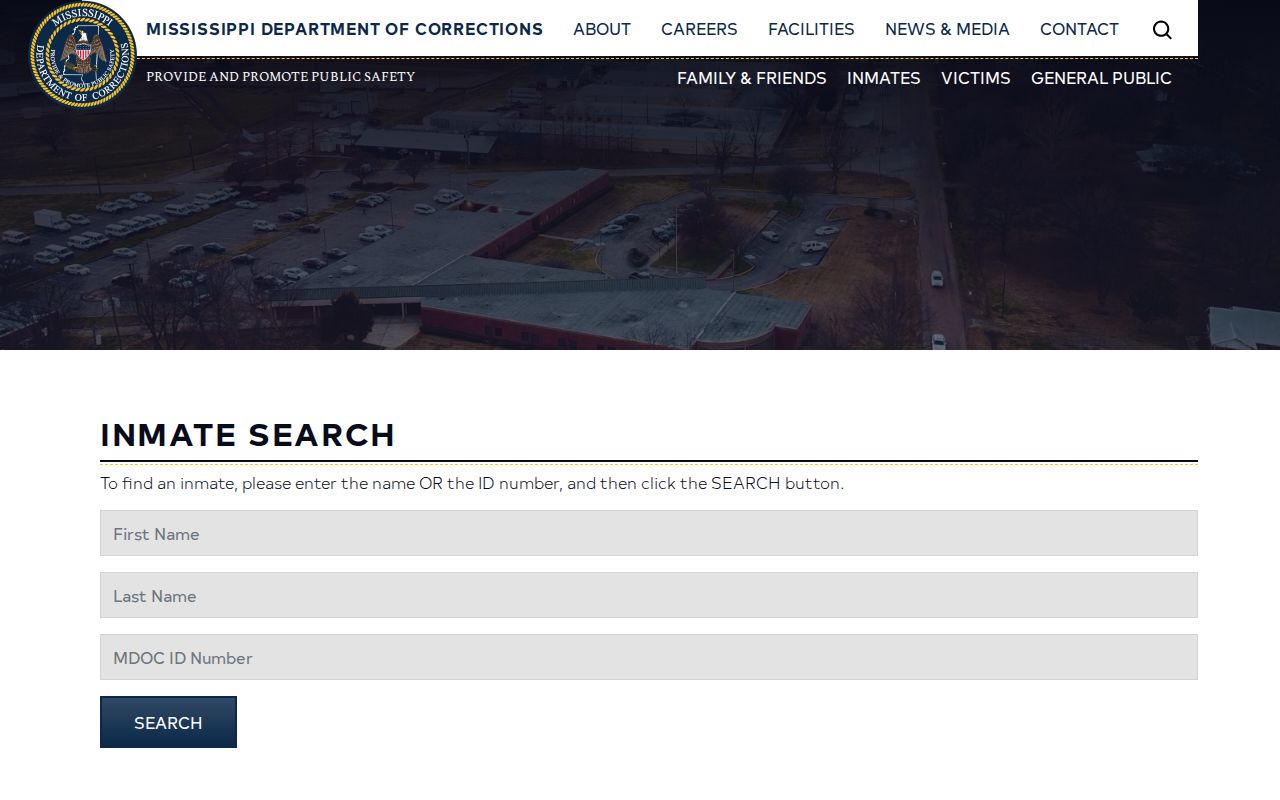
The captured portal identifies the correct state system, while the opened detail or Records response supplies person-specific release evidence.