
Smith Office Supervision Records
The Smith Probation & Parole Office is an MDOC community-corrections office. It does not hold inmates, process jail releases, or maintain a county booking roster. A person may report there after release on parole, probation, earned-release supervision, or another qualifying community status. The office's role is field supervision in the community.
That distinction changes what “released from here” means. No one exits this office from incarceration. Instead, an MDOC record may show that a person left confinement and now has a Smith County supervision assignment. A person can also begin probation under a court order without first serving a prison term. The supervising record and the court or release record must be read together.
Check Smith County Supervision Release
MDOC maintains separate inmate and parolee searches. The inmate lookup addresses present state incarceration. The parolee lookup is the better released-first tool for a person under community supervision. Smith County appears as a narrowing choice, and the search also accepts a first name, last name, MDOC number, and city.
- Open the MDOC parolee search and enter the person's name or MDOC number.
- Use Smith County as a filter only when a local assignment is expected.
- Compare the ID number, name, location, and offense in the result list.
- Open the detail and review the county, supervising officer, offenses, photograph, and flat-time date.
- Contact the local office for assignment or reporting-route questions, or MDOC Records for an official status document.
A flat-time date is not necessarily the day the person physically left prison. It relates to the sentence record. Likewise, a parolee listing verifies MDOC community status, not final discharge. If no result appears, check spelling and the MDOC number, then ask the correct record owner. Never infer absconding or a warrant from a failed public search.
Smith Supervision Office Contact
The official MDOC facility page supplies a direct address, phone, and fax. Use these channels for questions about the correct local reporting office or published office instructions. An office call should not seek a private residence, reporting schedule, or any detail unrelated to the caller's legitimate need.
Smith Probation & Parole Office230 Magnolia Drive
Raleigh, MS 39153
Phone: 601-782-9512
Fax: 601-782-4471
Hours: use the official office lookup or call to confirm
For an official parole decision, contact the Mississippi State Parole Board. For computation, discharge, or a certified MDOC record, use MDOC Records. The local office is a practical field contact, but statewide offices own different parts of the record.
Note: Confirm the office assignment through the statewide record before sharing personal details by telephone.
View Smith Supervision Office Source
The official MDOC Smith office listing identifies this Raleigh location as a probation and parole office rather than a place of confinement.
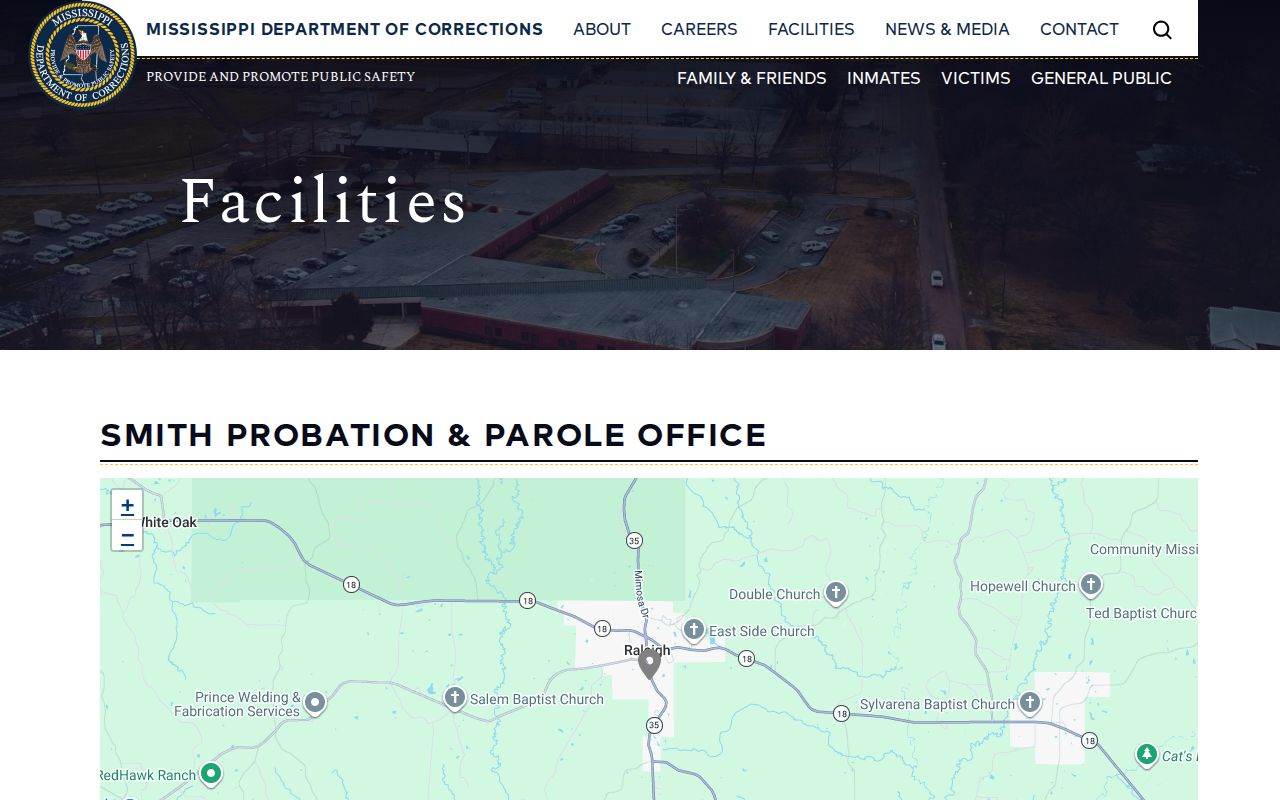
The published listing supports the local contact route, while a named person's status should still be checked through the separate statewide parolee record.
Smith Release Versus Discharge
A community-supervision record often shows that confinement ended, but the sentence remains active. Parole is conditional release authorized by the State Parole Board. Probation is supervision ordered by a court. Earned-release supervision is a conditional MDOC mechanism under which the person remains in inmate status and MDOC jurisdiction through the relevant term. Final discharge is a stronger endpoint documented by the responsible agency.
| Status | What it supports | Best record |
|---|---|---|
| Parole | Release from confinement under Board conditions | Parolee detail and Board action |
| Probation | Court-ordered community supervision | Judgment and MDOC supervision detail |
| Earned-release supervision | Conditional community status under MDOC jurisdiction | MDOC computation and supervision record |
| Discharge | End of the documented sentence jurisdiction | MDOC discharge certificate or Records response |
The difference matters when reconnecting with someone or confirming required supervision. A person may be out of a cell yet still have reporting terms. Conversely, probation does not prove a prior prison release. Match the claim to the record actually found.
Smith Supervision Record Fields
The parolee search accepts first name, last name, MDOC ID, city, and county. Results include an ID number, names, location, offense, and a link to view more. A detail may include a photograph, supervising officer, location or county, offenses, and flat-time date. Residential data should not be copied or republished.
| Field | How to read it |
|---|---|
| MDOC ID | Use it to distinguish people with similar names |
| Location or county | Supports the assigned supervision area |
| Supervising officer | Identifies the MDOC field assignment shown |
| Offense | Connects the result to the state sentence record |
| Flat Time Date | A sentence milestone, not a guaranteed prison exit date |
For a correction, identify the exact disputed field and attach the controlling court order or other source document. Send the issue to MDOC when it concerns the supervision database. The Smith County Sheriff owns local booking and release fields, while a court clerk owns its docket and orders.
Smith Release Record Owners
Several offices may hold parts of one timeline. The detention center can document departure from the county jail. MDOC can document state confinement, computation, supervision, and discharge. The Parole Board owns its actions. A court record can show probation, sentence terms, revocation, or dismissal. No single public search reliably replaces all four.
- Parole
- Conditional release granted by the State Parole Board.
- Probation
- Community supervision imposed by a court.
- Absconder
- A supervision term for a person alleged to have stopped reporting or left supervision without authority.
- Discharge
- The documented end of an agency's sentence jurisdiction.
No official statewide public absconder list was found in the research. A missing search result is therefore not proof of violation, revocation, or a warrant. Ask the responsible agency for the narrow status that can lawfully be confirmed.
Smith Community Release Path
The basic state path is: incarceration, authorized release, community supervision, and discharge. Not every person follows every stage. A county detainee may receive probation without MDOC prison placement. A state prisoner may leave on parole or earned-release supervision. Someone else may remain confined until the maximum term and then discharge.
The parolee search is strongest for an active community phase. It should not be stretched into proof of the physical release time. For that event, use the releasing institution's record. If a person came from Smith County Detention Center, begin with the county booking/release entry. If a person came from an MDOC institution, request the state release or discharge document.
The Smith County release search explains how county, state, court, VINE, and federal records fit together. Use only the branch supported by the person's actual jurisdiction.
Smith Release Navigation Resources
The Capital Central Reentry Resource Guide includes Smith County contacts and regional routes for legal, identification, transportation, and agency navigation. It is a secondary directory, and PDF entries can age. Confirm each contact with the named agency before relying on it.
Record ownership remains the best guide. Ask the Sheriff about a local booking. Ask the court about its order. Ask MDOC about state custody or supervision. That keeps correction requests focused and prevents the Smith Probation & Parole Office from being treated as a general records desk for every release in the county.
Note: A regional directory can help locate an office, but only the record owner can correct or certify its own release field.
Verify Smith Supervision Release Status
Start with the parolee search, then confirm the office assignment. Read the status as active supervision unless a discharge document says otherwise. If the question concerns a Board action, use the Parole Board. If it concerns sentence computation, use MDOC Records. If it concerns a county jail departure, return to the Sheriff.
This sequence protects a key boundary: release into supervision is not the same as full discharge. It also avoids calling a community-corrections office a detention site. The Smith office provides a concrete local contact, but the statewide record and originating release document supply the proof.
Keep the search date with the result, since supervision assignments and public status fields can change as the documented sentence moves toward discharge.