
Smith County Parole and Probation
Parole and probation can both place a person under rules in the community, but they begin in different ways. Mississippi parole is conditional release from confinement authorized by the Mississippi State Parole Board. Probation is supervision ordered by a court and may begin without a prison release. Earned-release supervision, often called ERS, is another MDOC status. Under ERS, the person remains in inmate status and under MDOC jurisdiction through the applicable term even while living outside prison.
This distinction controls which Smith County record to check. A parolee or ERS record points to MDOC Community Corrections. A probation question may also require the sentencing order and later court entries. None of those records should be confused with the Smith County Detention Center release sheet, which establishes when a particular county booking ended.
| Status | Who authorizes it | What verifies it |
|---|---|---|
| Parole | Mississippi State Parole Board | Board action, then the MDOC parolee record after release |
| Probation | Sentencing court | Judgment, probation order, and MDOC supervision record when applicable |
| Earned-release supervision | MDOC under sentence law | MDOC computation and community-supervision status |
- Parole
- Conditional release from prison before the sentence has fully ended.
- Probation
- Court-ordered supervision that may be imposed instead of, or after, confinement.
- Discharge
- The agency's formal end of custody or supervision obligations for the stated sentence.
- Absconder
- A supervision label for a person alleged to have stopped reporting or whose location is unknown. A missing search result does not establish this status.
Verify Smith County Post-Release Supervision
Use MDOC's two searches for different stages. The inmate search addresses present state incarceration. The MDOC parolee search is the stronger released-first channel for someone who left prison into community supervision. It accepts first name, last name, MDOC ID, city, and county, and Smith is available as a county filter. Results can show the MDOC number, name, location, offense, and a detail link. The detail may add a supervising officer, county, photograph, offenses, and Flat Time Date. A Flat Time Date is not necessarily the day the person physically left prison. It relates to the sentence record. Compare the person’s name and MDOC number, then read the current location and supervision fields. If the question is whether every obligation has ended, request a discharge record from MDOC Records instead of treating a parolee result as final sentence completion.
- Search the parolee database by the exact name or MDOC ID. Use Smith County to narrow a broad result set, not to assume where a person lives.
- Open the matching detail and compare identifiers, offense, location, county, supervising officer, and Flat Time Date.
- Contact the Smith Probation & Parole Office for local office-assignment or reporting questions. Avoid seeking private details that are not needed.
- Ask the Parole Board about an individual parole decision. Ask MDOC Records for a computation, release certificate, or final discharge record.
- Read the sentencing court record when probation, an amended sentence, or a revocation is involved.
The official parolee search screen shows the Smith County selector and the statewide search fields.
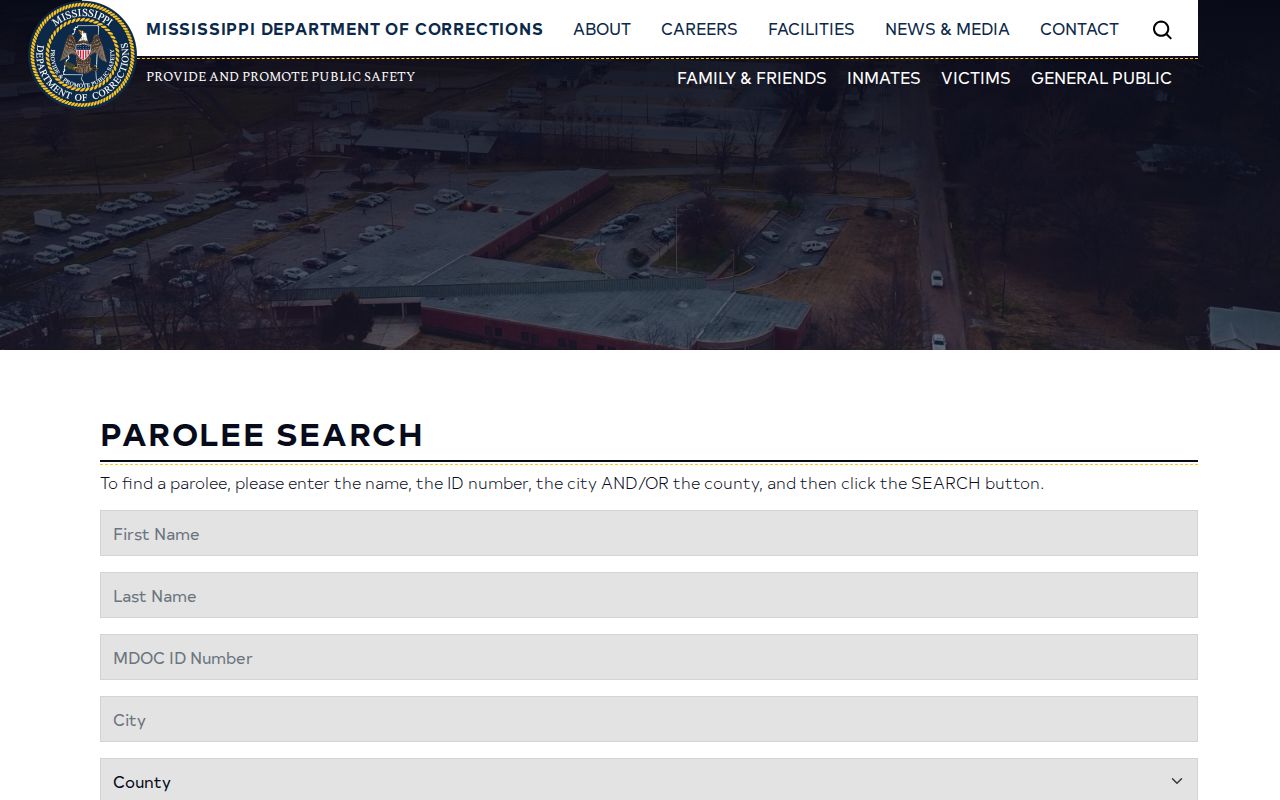
The county filter helps isolate a supervision record, but the opened detail and the responsible office must confirm that it is the correct person.
Note: A failed parolee search can reflect spelling, status, or system coverage and does not prove discharge, a warrant, or absconder status.
Smith County Parole Hearing Records
The Mississippi State Parole Board makes parole decisions, while MDOC calculates dates and supervises people after release. The agencies should not be merged. The available administrative rules describe monthly scheduling, with a hearing generally held no later than the month before eligibility and possibly during either of the two prior months. Review may occur by file, in person, by telephone, or by teleconference, depending on the case and governing rule. Hearings are closed to the public.
No official person-level public hearing calendar or decisions database was confirmed. The rules call for a written decision after deliberation, and a denial action sheet provides reasons and a set-off before later review. A set-off is the period before another parole review. Board records can include a grant, denial, later revocation, or a qualifying presumptive-parole action. A grant is permission to proceed, not proof that release processing finished.
Eligibility under Miss. Code § 47-7-3 depends on offense, sentence date, and exclusions. The accessible rule summary describes different fractions for eligible sentence groups. It also excludes specified offenses and offender classes. Because the Secretary of State file available during research was labeled as proposed, confirm the current law and case computation with the Board instead of applying a broad fraction to one person.
Smith County Parole Office Details
Smith County has a named MDOC community-corrections location in Raleigh. That provides a direct route for local reporting and office-assignment questions once the statewide record identifies community supervision. The office is not a jail and does not replace MDOC Records or the Parole Board. Its role is field supervision, so an office contact supports the local part of a parole, probation, or ERS inquiry.
Smith Probation & Parole Office
230 Magnolia DriveRaleigh, MS 39153
Telephone: 601-782-9512
Fax: 601-782-4471
The official Smith office listing is the source to recheck before a visit or call. The page publishes a direct line and fax, but the research did not confirm public walk-in hours. A statewide status or formal record question should go to the appropriate central office. MDOC Records receives sentence-computation and discharge inquiries at P.O. Box 24388, Jackson, MS 39225, by telephone at 601-933-2889, or at MDOCRecordsDepartment@mdoc.state.ms.us. Verify those channels through the MDOC contact directory before sending a request.
Mississippi State Parole Board
239 North Lamar Street, Suite 501Jackson, MS 39202
Telephone: 601-576-3520
Email: MSStateParoleBoard@mdoc.state.ms.us
The official office page also provides a visual check on the named Smith County supervision location.
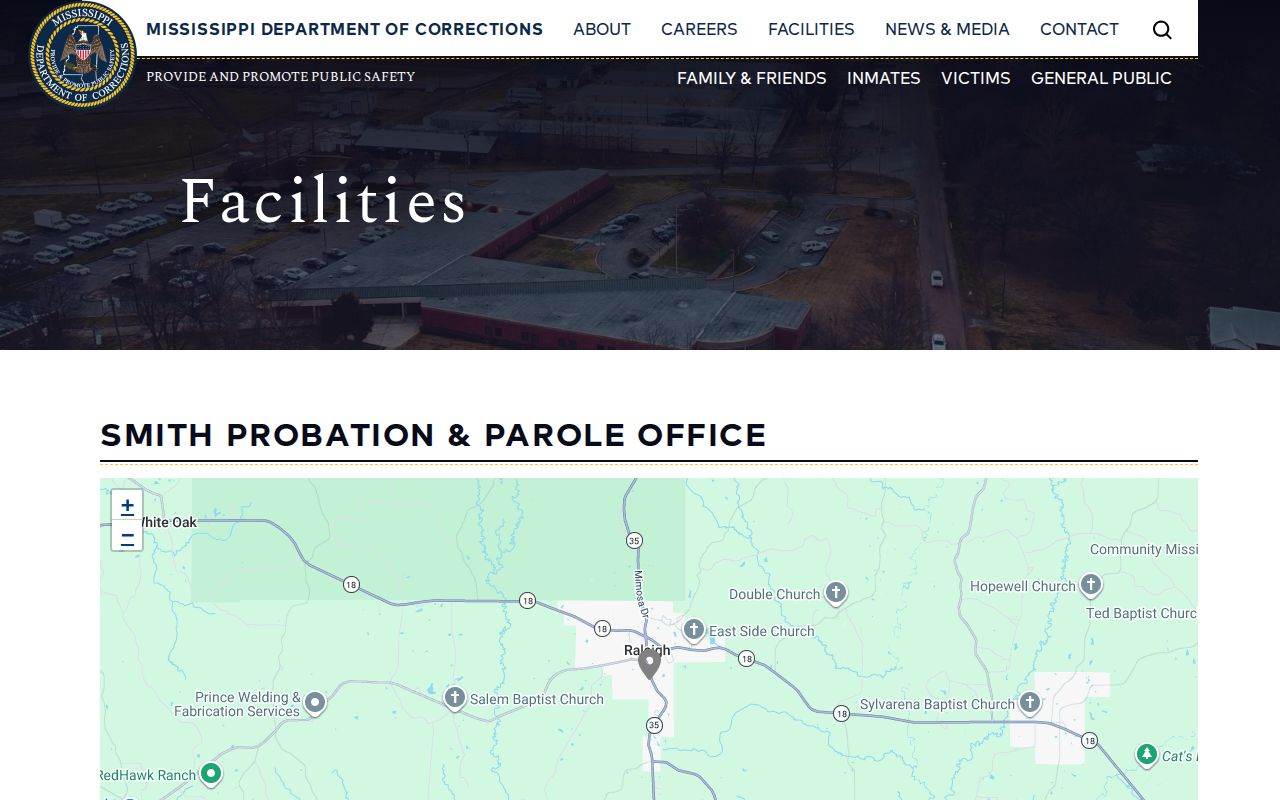
This listing confirms that the Raleigh location is a community-corrections office, not a detention facility or a public archive of all past cases.
Smith County Supervision Violations
Conditions are the rules attached to parole, probation, or ERS. They can include reporting and other limits set by the court, Board, or MDOC. The specific order and supervision record control. A suspected violation does not itself prove that supervision has been revoked. Revocation is the process that may return a person to custody after the responsible authority acts.
Mississippi SAVIN/VINE can send notices for certain custody and supervision events from participating agencies, including transfer, return to custody, escape, absconding from supervision, and release. It is a useful alert channel, but not the official supervision file. If an alert says transfer or return to custody, confirm the reporting agency and receiving location. A transfer means custody continued. If the parolee search has no match, do not label the person an absconder or say a warrant exists. No authoritative public statewide absconder list was found in the Smith County research.
A roster or database gap is not a violation record. Confirm supervision with MDOC, and confirm a warrant only through the agency or court that owns it.
Note: Probation can start without a prison release, while parole and ERS follow state confinement and retain different forms of sentence control.
Correct Smith County Supervision Records
Smith County publishes no single correction process for every release or supervision record. Ownership determines where the request goes. The Sheriff owns county booking and release data. The Circuit Clerk or relevant court owns its docket and orders. MDOC owns prison, parolee, and community-supervision data. Asking one office to rewrite another agency’s system is unlikely to resolve a mismatch.
A useful correction request names the person and record number, quotes the exact field in dispute, states the requested correction, and attaches the controlling order or other proof. Ask the custodian for its correction procedure and a written outcome. When the conflict concerns the physical date a Smith County booking ended, start with the Sheriff’s release sheet. When it concerns probation terms, use the sentencing order. For an MDOC location, officer, release computation, or discharge field, contact MDOC.
The broader Smith County released inmate search and records path explains how the jail, court, and state systems fit together. Use only the branch that owns the disputed fact.
Smith County Post-Release Resource Routing
The Capital Central Reentry Resource Guide includes Smith County contacts and regional routes for legal, identification, transportation, and agency navigation. It can help someone determine which public office handles a post-release need. The PDF can age, so check each phone number or program against a current primary source before relying on it.
Keep the route tied to the record question. The Smith office handles local supervision reporting. MDOC Records handles state custody and discharge documentation. The Parole Board handles parole decisions. The Sheriff handles the county booking and release event. The clerk supplies court orders and docket material. This separation is especially useful when a person has left confinement but still appears under parole, probation, or ERS.
The Capital Central guide is a secondary navigation aid. Confirm all listed details before travel.
Smith County Supervision Discharge
Release from confinement and discharge from supervision are separate milestones. A person can be physically outside a prison and still remain under sentence jurisdiction on parole or ERS. Probation also continues until the court or responsible agency records completion or takes another action. The strongest proof of the end of state supervision is an official discharge record, not an old search screenshot.
Request the relevant MDOC record by name and MDOC number or another sufficient identifier. Ask for the release or discharge certificate, actual release type and date, sentence-credit computation when needed, and final custody or supervision status. A court matter may also require the final order. If the parolee detail remains online after an expected end date, ask MDOC what the current field means rather than assuming it is stale. If it disappears, make the same inquiry because removal alone does not prove discharge.
For county confinement, the Smith County Detention Center release sheet answers when that booking ended and whether the person transferred. For state supervision, MDOC and the Parole Board control. Keeping these records distinct produces a defensible timeline from confinement, through parole or probation, to final discharge.