
Smith County VINELink Release Coverage
Mississippi SAVIN/VINE is a custody-information and notification service. The official state description says it handles county and state offender events generated by changes in participating agencies’ booking systems. Named events include release, transfer, return to custody, escape, and absconding from supervision. Anyone may register anonymously through the service.
Coverage is not a promise that every Smith County booking or MDOC event will appear. Research did not confirm a stable public Smith-specific VINE agency page or a safe released-person example. Search the live service and inspect the reporting agency. If Smith County does not appear, or the matched record is stale, contact the Detention Center. VINELink is not a federal BOP locator and does not replace an agency’s certified release record.
County and state coverage should also be kept distinct. A Smith County event comes from the participating jail’s booking system. An MDOC event concerns state incarceration or a related state status. The same person may cross that boundary after a county transfer. A VINE result tied to MDOC does not prove the date Smith County staff released the person from their control, and a Smith County event does not prove final MDOC discharge.
- VINE
- The custody-status and notification program.
- SAVIN
- Mississippi’s statewide automated victim-information network.
- Release event
- A reported end to custody in the participating agency’s record.
- Transfer event
- A move to another custody system, not a return to the community.
Search Smith County VINELink Records
Start at the official VINELink search. Gather the exact name, spelling variants, and any identifier already found in the jail or court record. Use only enough identifying data to select the right result, and do not publish private identifiers simply because they help with matching.
- Choose Mississippi and open the person-search option shown by the live interface.
- Enter the exact first and last name. Add an offered identifier or spelling variant when needed.
- Compare possible matches by agency and the identifying details displayed. Do not choose a record from name alone when several people match.
- Open the correct record and read the custody status, reporting agency, location, and event information shown.
- Save the agency name and update time. If the record says released or transferred, verify that event with the reporting agency.
If no result appears, retry reasonable name variants and check the jurisdiction. A no-result can stem from spelling, stale data, a transfer, participation differences, or removal of an older entry. It is not evidence that the person was released. The Smith County released-inmate verification route provides the jail, court, MDOC, and specialized alternatives for an unresolved match.
Smith County VINELink Release Fields
The live record controls which fields are available. Agency feeds differ, so do not promise a fixed screen or turn a scheduled date into an actual release. A matched result may expose the following types of information.
| Field | Safe interpretation |
|---|---|
| Person and identifier | Helps distinguish the selected custody record from another person with a similar name. |
| Reporting agency | Names the jail or correctional system responsible for the event feed. |
| Custody status | Shows the agency’s reported in-custody, released, or out-of-custody language. |
| Facility or location | Identifies the reported custody site or system when the feed supplies it. |
| Event and update time | Places a reported release, transfer, return, or other change in context. |
| Notification options | Shows which events and delivery channels can be selected for that record. |
A VINE event is relational. A release from Smith County custody can still be a transfer to MDOC, another jail, USMS, or ICE. A court disposition explains what happened in the case, while the reporting jail’s release entry proves the physical county exit. Final MDOC discharge may require a Records response or discharge certificate.
Scheduled and actual dates need the same care. MDOC’s inmate detail may show a Tentative Release Date, which is an estimate after applicable adjustments. Its separate parolee detail can show community-supervision fields and a flat-time date. Neither field should be inserted into a VINE result unless the live VINE screen actually reports it. When timing matters, compare the notification with the correct agency record.
Note: Save the reporting agency and timestamp because status terms and update timing can differ across participating feeds.
Register Smith County Release Alerts
Notification works best while the correct person is still shown in custody. Register from the matched record rather than from a broad search result. Available events and delivery channels can change, so follow the live prompts and choose only options displayed for that agency.
- Open registration or notifications from the confirmed person record.
- Select the offered events, such as release or transfer, that matter to the custody question.
- Choose an available phone or email delivery method and enter your own contact information.
- For telephone alerts, create the PIN requested by the live interface and retain it privately for acknowledgment.
- For email, complete any confirmation message. Review the saved registration before leaving the service.
Do not register another person’s phone number or email without permission. The PIN protects notification handling. It is not an inmate or custody identifier, and research did not establish a permanent PIN length. Describe the live prompt rather than relying on an old set of instructions.
MS SAVIN offers support at 601-359-5759 during standard business hours. Its 24-hour English and Spanish line is 1-888-9-MSSAVIN, and TTY support is 866-847-1298. These contacts can help confirm automated information, but they do not replace a certified Smith County jail record.
Keep confirmation details private after registration. Telephone alerts may ask for the saved PIN when a call arrives, while email may require a separate confirmation. The live screen controls. If an alert is missed or a phone number changes, return to the matched record and review the current options instead of creating duplicate registrations with someone else’s contact data.
Confirm Smith County VINELink Releases
Treat the alert as the start of confirmation. A release alert says that the reporting agency recorded a custody change. It does not state why the criminal case ended, erase another detainer, or prove all sentence obligations are complete. A transfer alert affirmatively points toward continued custody.
| Situation | Confirmation source |
|---|---|
| Smith County release event | Smith County Detention Center booking/release entry. |
| Smith County transfer event | County release record plus the named receiving agency. |
| MDOC incarceration | MDOC inmate search and Records Department when timing is material. |
| MDOC community supervision | Separate MDOC parolee search and the supervising office. |
| Federal custody | BOP locator or the proper USMS/federal record path, not VINELink. |
Call the Smith County Detention Center at 601-782-4531 for the actual county release date, time, disposition, and receiving agency. The facility is at 206 Courthouse Square, Raleigh, MS 39153. Public hours were not posted, so call before visiting. For state records, MDOC maintains distinct inmate and parolee searches because confinement and community supervision are different statuses.
The Smith County current roster can resolve a second question. A present match supports current county custody at the time of review, subject to data lag. An absent name does not confirm release. Pair the roster check with the VINE timestamp, then ask jail staff about the precise booking. This avoids confusing a data correction, court movement, hospital trip, or transfer with a return to the community.
Smith County Release Alert Continuity
Mississippi SAVIN describes an Enhanced VINE feature called Registration Link. When a county offender moves to MDOC or other custody, an existing registration may carry into the next system. This matters in Smith County because removal from the current jail roster may reflect transfer rather than release into the community.
Read the first alert closely. If it says transfer, preserve the receiving-system details and continue the notification trail. Do not rewrite the event as release to the community. Registration continuity can reduce a blind spot at the county-to-state boundary, but the receiving agency still controls the new custody record.
The official VINELink landing screen is shown in the successful manifest capture below. It is the source entry point for person search and registration.
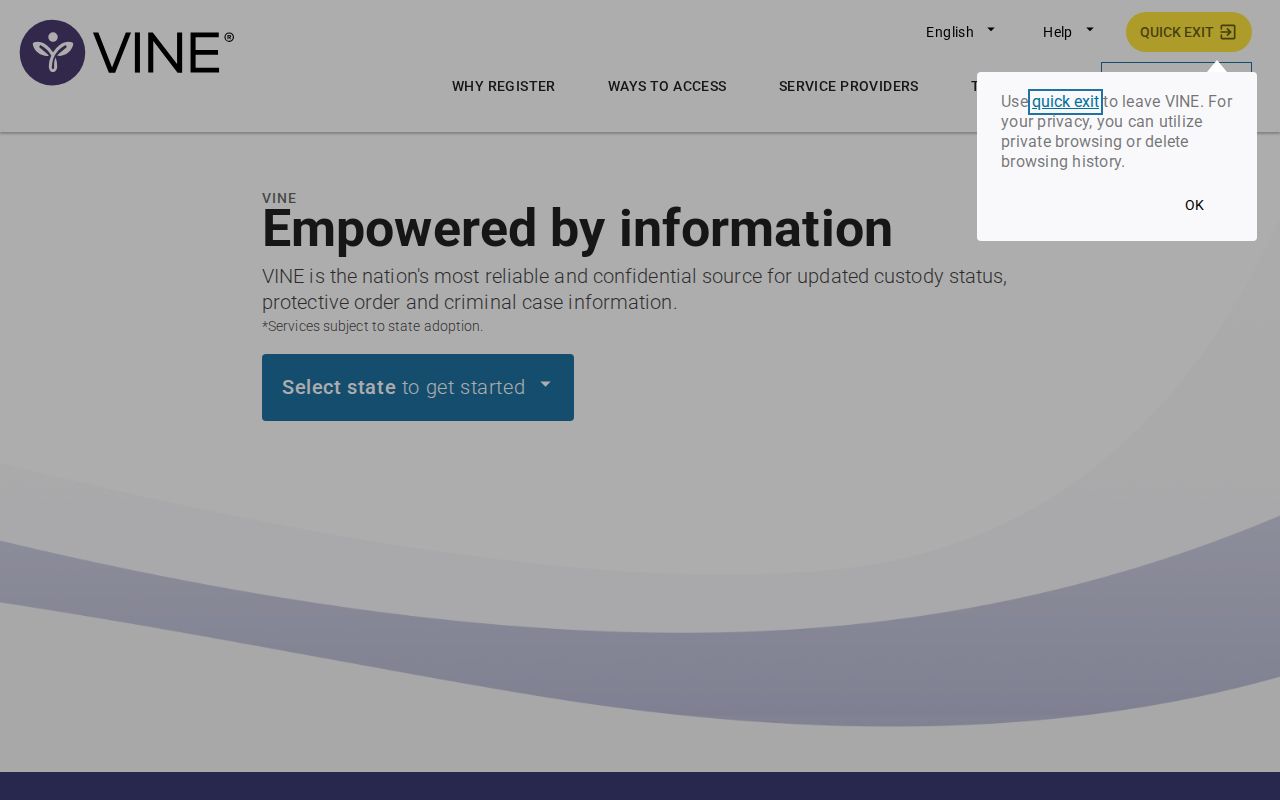
The screen confirms the national VINELink entry route. Agency participation and available Smith County record options must still be checked live.
Note: Registration Link supports continuity across systems; it does not certify that a transfer record is complete or current.
Resolve Smith County VINELink Conflicts
Conflicts are resolved by record ownership. The Sheriff owns Smith County booking and release data. A court clerk owns the docket and controlling orders. MDOC owns its incarceration, computation, supervision, and discharge records. VINELink relays custody changes reported by participating systems.
If VINELink says released while the current roster still shows the person, note both timestamps and call the jail. If VINELink says in custody after the roster drops the name, ask whether the record is stale or whether the person transferred. When every public search returns no match, check spelling, identifiers, dates, and jurisdiction before making a narrow records request.
The proof chain is simple: VINE event, reporting agency’s release entry, receiving agency when named, then court disposition for the legal outcome. No single missing result should be converted into a release claim.
Specialized systems stay in their own lanes. The Mississippi sex-offender registry applies only to people legally required to register and does not supply a general release date. The BOP locator concerns federal custody. ICE’s locator concerns immigration detention. Use one only when the case or receiving-agency record points to that jurisdiction.